What this service covers
Fan-driven systems designed for the foundation in front of us: a block-wall basement from the 1970s, a Hamburg-area slab, a vented crawl under a Versailles ranch, or some combination. Every install is performed by a mitigation contractor holding NRPP or NRSB credentials and the certification Kentucky requires under KRS 309.436, built to the ANSI/AARST SGM-SF-2023 standard, and finished with a verification retest so the before and after numbers sit side by side on paper.
Typical pricing
$1,200-$2,500
Pricing varies by job specifics. Free phone or on-site quotes; fixed pricing once the technician has assessed the job.
What an active system actually does under a Lexington house
Radon rides the soil gas, and soil gas follows pressure. Through a Kentucky heating season, warm air rising inside a closed house leaves the lowest floor at slightly lower pressure than the ground outside it, and the ground answers by pushing gas up through whatever the foundation left open: the joint where floor meets wall, shrinkage cracks, plumbing penetrations, the open cores of a block wall, bare crawl-space dirt.
An active sub-slab system reverses the contest. A small pit is cored through the slab, sealed pipe connects it to an inline fan, and the fan holds the soil beneath the floor at lower pressure than the room above, so the gas chooses the pipe and exits above the roof. The EPA's Consumer's Guide to Radon Reduction credits active sub-slab suction with reductions of 50 to 99 percent, which is why it is the default answer for basements and slabs, while a crawl space gets the same physics under a sealed membrane instead of a slab.
The inner Bluegrass adds its own wrinkle. The limestone under these counties is karst, full of solution-widened joints and sinkhole plumbing that the US Geological Survey's regional radon assessment describes as unusually good at moving soil gas. A diagnostic check of how air communicates under the slab, before any pipe is glued, is what separates a system sized for this ground from one copied out of a catalog. Our pricing guide by foundation type shows how those findings become a number.
Who is allowed to do this work in Kentucky
Kentucky puts radon work behind a certification wall. Under KRS 309.436, nobody may perform radon measurement, mitigation, or laboratory analysis for hire in the Commonwealth without being certified, and the Kentucky Board of Radon Safety is the body that issues and enforces those certifications. Certification rides on the national proficiency programs, so the person designing your system carries an NRPP or NRSB mitigation credential alongside the state's authorization.
That wall matters more than it would in a state with its own install rulebook. Kentucky does not publish a state mitigation standard the way Ohio does; the working standard here is the national one, ANSI/AARST SGM-SF-2023, which governs suction-point placement, pipe sizing, fan location outside the living space, discharge above the roofline, system labeling, and the gauge that proves the fan is pulling. Ask any bidder which standard the install follows and which credentials the Board's registry shows for them. A certified professional answers both without reaching for notes.
One more piece of context worth knowing: the state Department for Public Health once ran a radon program, and it ended on June 30, 2024. The certification law outlived it, so enforcement and professional discipline now sit with the Board of Radon Safety. Any website still pointing you to the old health-department program is out of date. Our regulation FAQ covers what changed and what did not.
How inner Bluegrass foundations shape the design
The rock sets the odds here. The Lexington Limestone and the High Bridge Group beneath it are phosphatic, uranium-bearing Ordovician rocks, and the Kentucky Geological Survey names phosphatic limestones, together with black shales, as the rock families behind Kentucky's worst radon. The 2017 state health cabinet release put more than 55 percent of tested Fayette County homes at elevated levels, so no foundation type around Lexington gets a pass.
What changes house to house is the path the gas takes. The 1960s through 1980s ranches that fill neighborhoods off Tates Creek, Richmond Road, and the Versailles and Lawrenceburg grids sit on concrete-block foundations, and block is honest about nothing: gas moves through its open cores and mortar joints as readily as through a floor crack, so those walls get top sealing and the design sometimes draws from the wall cavity itself. Pre-war houses in Paris, Midway, and downtown Lexington bring stone foundations whose entire face leaks, which shifts the budget toward sealing and occasionally a second suction point.
The growth-ring subdivisions in Georgetown, Nicholasville, and Richmond are mostly poured basements, walkouts, and slabs, the simplest cases, and some carry a builder's passive pipe that only needs a fan. Split-foyers and ranch additions mix a slab with a crawl, and each part needs its own treatment. The county and town table maps the housing patterns across the service area.
The quote, the install, and the proof
A mitigation job here produces three documents, and each one protects you. First the written quote: a fixed price tied to a named scope after the house has actually been looked at, listing the foundation type, the suction-point plan, the fan model and where it goes, the discharge route, and what gets sealed. Most Lexington-area basement and slab systems land between $1,200 and $2,500; crawl spaces needing a full membrane run $1,800 to $3,600.
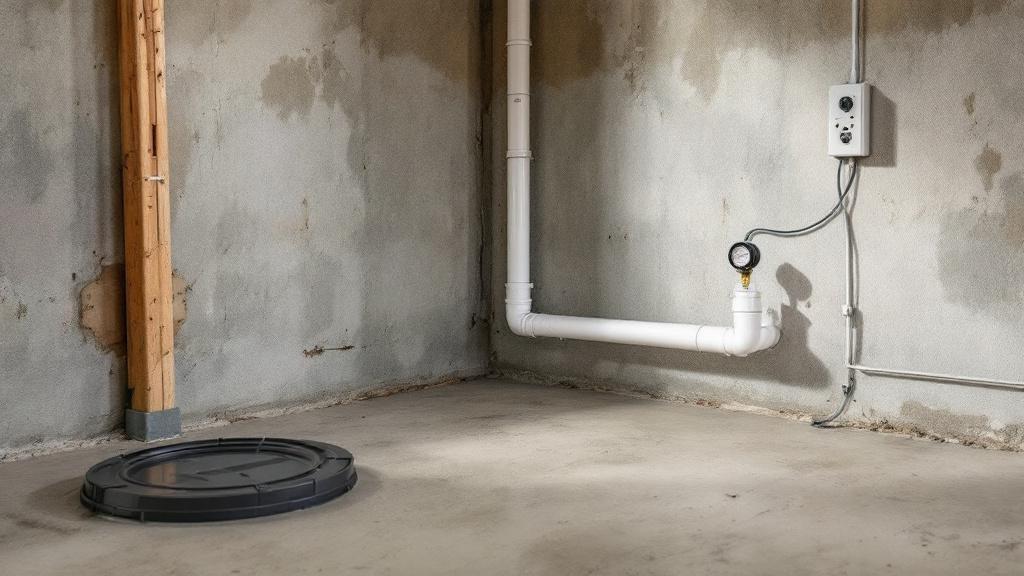
Second, the install itself leaves evidence you can check against ANSI/AARST SGM-SF-2023 without a ladder: the fan outside the living space, never in the basement; pipe labeled as a radon system; a manometer or electronic gauge on the pipe with its startup reading marked; the discharge terminating above the eave, clear of windows and doors.
Third, the verification retest. A post-mitigation measurement, run after the system has had time to settle the house, is the only proof the number actually moved, and under Kentucky's certification law a test performed for hire comes from a certified measurement professional. Keep all three documents with the house papers: the next buyer's inspector will ask for them, and a complete closeout package has settled more than one closing-table argument. Start with the cost question or the calculator for a first range.
Service area
Radon Mitigation Systems is available across Lexington and the inner Bluegrass. Per-suburb pages: